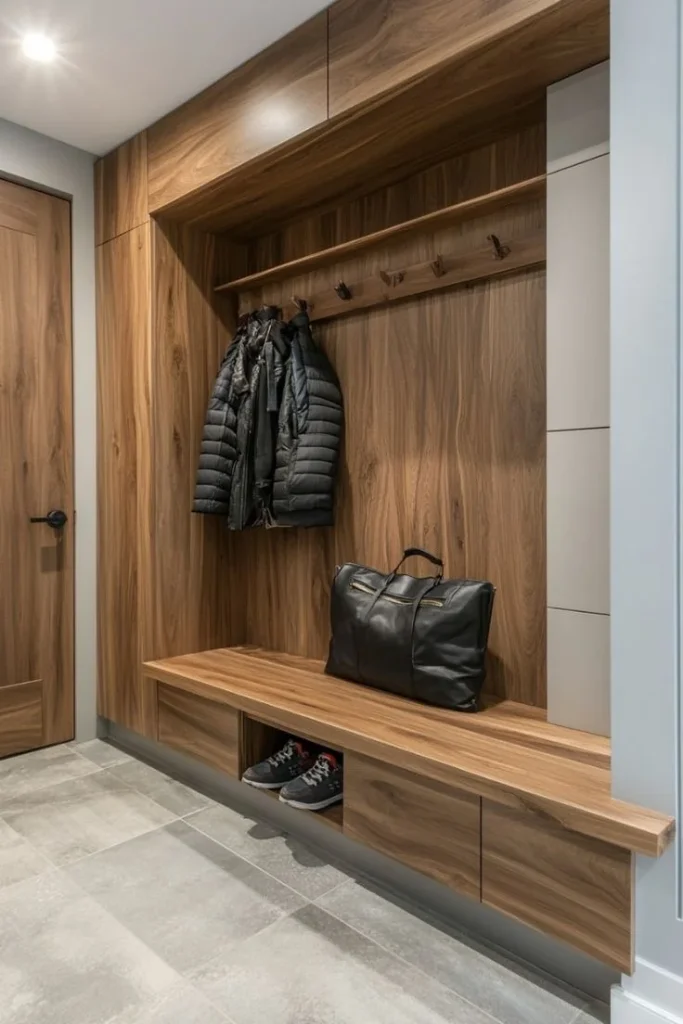
Entryway shoe storage ideas work best when the shoes have a place beside the spot where you take them off. An open bench puts pairs below the seat; a cabinet closes them away. Choose between them by looking at what you wear daily, whether you sit to change, and where an open compartment would reach.
A beautiful arrangement still needs to accommodate your actual footwear. The examples below show different ways to combine a seat, shoe space, and nearby storage, followed by checks that help you adapt the layout to your own doorway.
1. Put Shoe Space Directly Under the Entryway Bench
A bench with a clear opening underneath brings sitting and shoe storage together, as this wood-lined entryway shows with shoes in an open recess below the long seat and hooks on the wall above. The useful relationship is vertical: coats, a place to sit, and shoes each occupy a different part of the same wall.
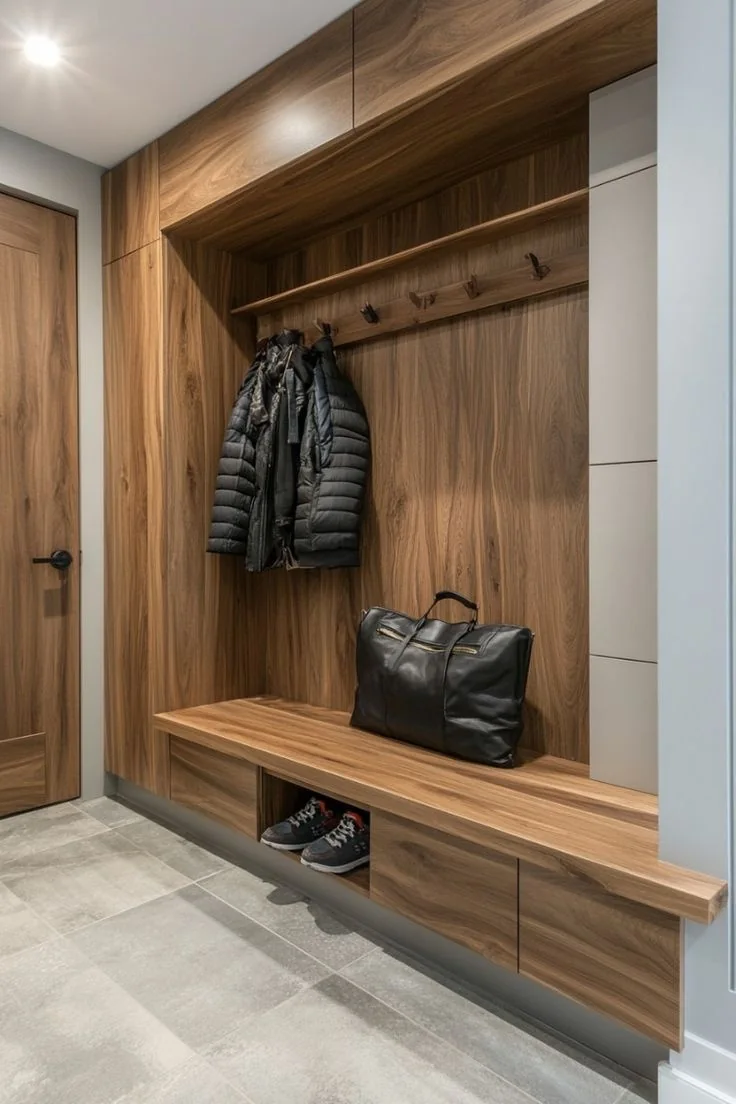
Borrow that relationship even if your bench is much simpler. Look at the opening from the seated position and consider how you would return a pair after taking it off. A recess that is awkward to reach may look tidy in a photograph while leaving your shoes on the floor in practice.
Leave a usable part of the seat available, too. The bag in the example shows how easily a bench can take on another job. If bags regularly occupy your whole seat, give them a separate resting place before adding more shoe compartments below.
Our broader home decorating guide considers how useful surfaces and everyday storage fit into a room. Here, the bench earns its place through the routine at the door.
2. Use a Tilt-Out Shoe Cabinet for a Closed Front
An open bench leaves footwear on display. A tilt-out cabinet offers a different front view, with shoes arranged inside compartments that tip forward. The white cabinet shown has two open tilting compartments, so you can see the angled arrangement behind the panels.
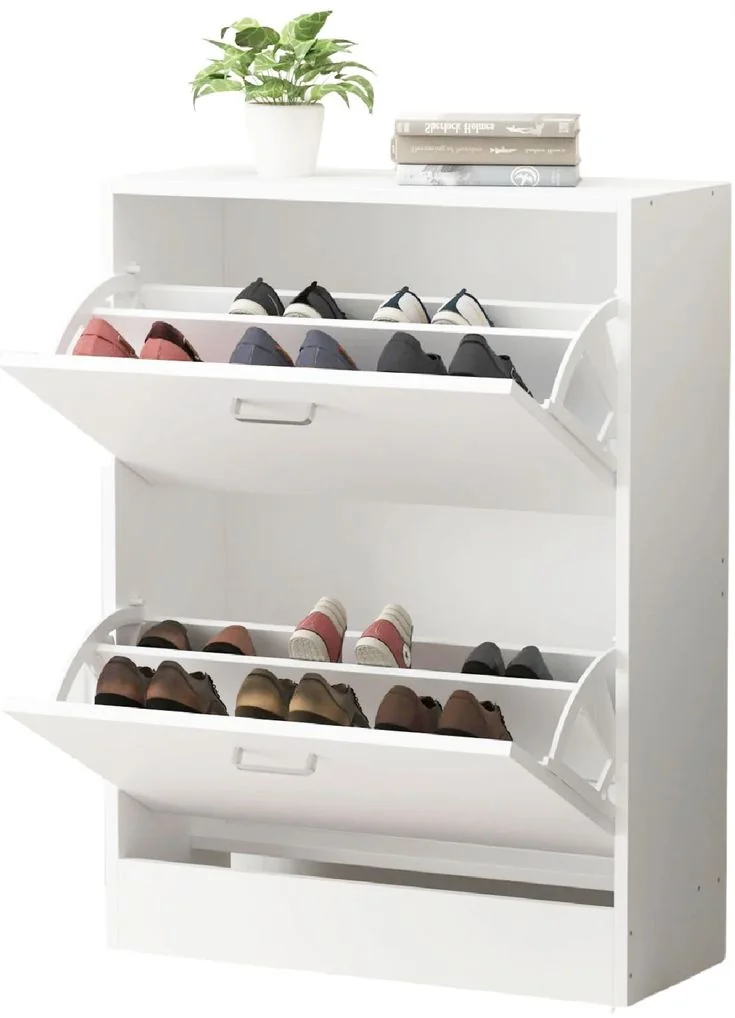
Treat this product display as a layout example. Before choosing a similar cabinet, compare its stated internal space with your shoes, including the pair with the thickest sole or highest upper. A photographed row of low shoes doesn’t establish whether your boots will fit.
Look at the compartment while open as well as closed. The projecting panel needs somewhere to go, and you need somewhere to stand while using it. Cabinet depth alone leaves out that part of the arrangement, especially beside an entrance door or a busy passage.
The top can also become a resting place for keys. Decide how much of it you want to use for daily objects before copying the plant and books in a styled display.
3. Choose Open Bench Shelves When Seeing Pairs Matters
If opening a cabinet feels unnecessary for the shoes worn every day, open shelves offer a more visible arrangement. This gray upholstered bench combines a seat with two shelves below. Shoes occupy both levels, showing how the space beneath a bench can be divided without individual doors.
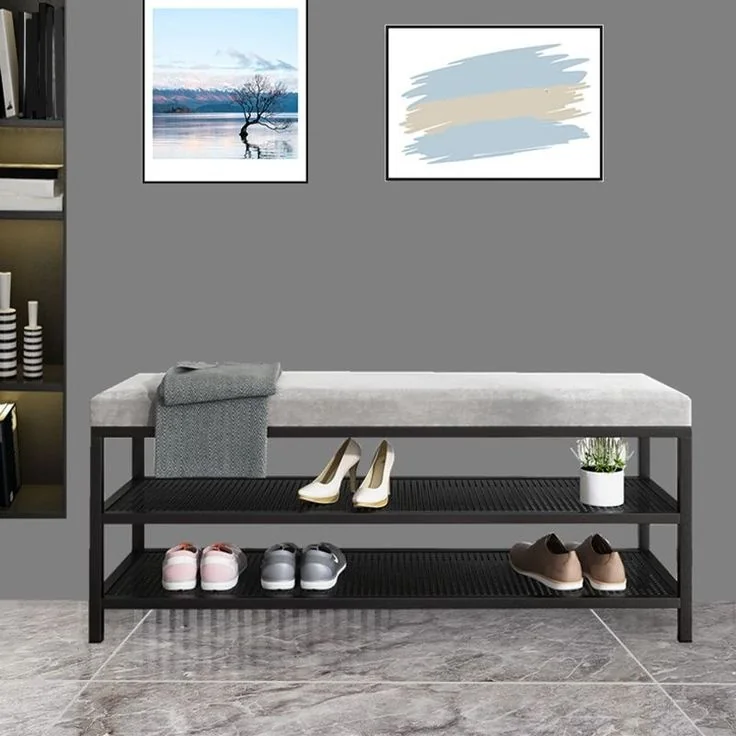
The display includes low footwear, so use it to compare the layout rather than assume a capacity. The height between shelves matters for your taller shoes, and the usable width matters for the pairs you want beside each other. Product measurements can help you rule out a bench whose openings don’t suit them.
Open storage also makes everything placed on the shelves part of the entryway view. The small plant in this example occupies shoe space. For a busy doorway, you might prefer to keep that shelf available and move decoration to an existing surface nearby.
4. Let a Nearby Cabinet Handle Small Entryway Items
Shoe storage gets harder to use when it also has to absorb every loose object coming through the door. A separate cabinet can give those items their own place while the bench remains available for changing shoes. In this room, a long wood bench sits beside a cabinet with woven drawers and a round upholstered stool.
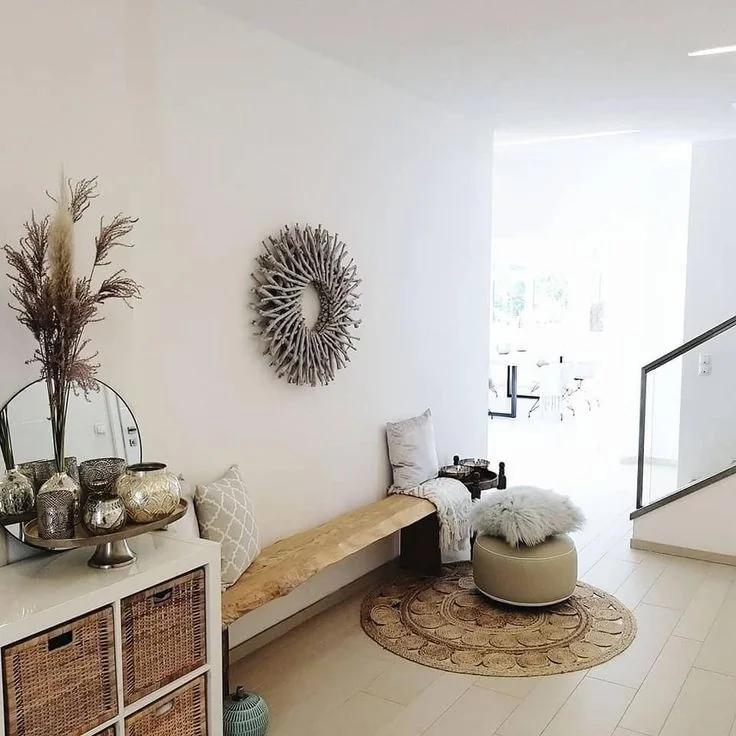
The image shows how the pieces sit together; it doesn’t reveal what is stored inside the drawers. Adapt the grouping by assigning nearby storage to the objects you bring in most often. Keeping gloves or small accessories there can leave the shoe opening free to do its own job.
You don’t need to copy every piece in the arrangement. A separate stool and a long bench may provide more seating than your entrance needs. Start with the furniture you use, then judge whether an additional piece contributes enough to justify its floor space.
5. Give Everyday Shoes Priority at the Door
Once the furniture has a clear job, decide which shoes belong in it. Begin with the pairs currently worn when leaving through that entrance. Arranging those first gives you a more useful starting point than trying to accommodate the whole household collection in the same opening.
There’s no fixed pair count that suits every doorway. A household using work boots and school shoes will need different openings from someone rotating between low sneakers. Compare the footwear itself with the storage space, rather than treating a seller’s pictured arrangement as your own capacity plan.
Leave a place for the pair you are wearing now. A cabinet filled to the edges may look organized while offering nowhere to return your shoes when you come home. If the daily group doesn’t fit, reconsider that group or the furniture before filling the surrounding floor.
6. Check Shoe Storage With the Door and Compartments Open
The daily group tells you how much storage you need; the way the entrance opens helps determine where it can go. Compare the entrance with its door open, then consider any cabinet panel or drawer that would project into the same area. A tidy closed view can conceal an awkward overlap.
For an existing arrangement, try the ordinary sequence of arriving, setting down a bag, and changing shoes, then notice whether you have to move an object before you can reach the shoe storage. That extra movement identifies a layout problem more clearly than judging the furniture only from the doorway.
For furniture you haven’t bought, mark out its stated footprint on the floor and consult its opening dimensions. Keep the walk from the entrance into the home usable throughout the comparison. These checks help narrow your choice without assuming that a photograph provides measurements for your room.
7. Keep Entryway Decoration Beside the Shoe Routine
After the shoes and seat have their places, add decoration where it can stay during an ordinary arrival. The examples use wall details, plants, books, and textiles in different amounts. Choose a detail that belongs on an available surface, with enough room left for the objects you set down each day.
A cushion that you move every time you sit may be less welcome than a wall picture you can leave alone. Likewise, a plant on a shoe shelf asks you to give up part of that shelf. Judge those exchanges against the space you actually use.
Start with the pair you take off most often and the place where it lands. Settle that small arrangement, then see whether the rest of the entryway needs a closed front, another shelf, or simply fewer objects sharing the seat. More room ideas at ZM Home can help you develop the surrounding space once the shoe routine feels comfortable.
For ideas that bring the whole room together, explore Home Decor Ideas for Rooms You Use Every Day.