Bathroom mirror ideas start with the sinks and the lights you’ve already got. A pair of round mirrors gives a double vanity separate curved outlines; a frameless rectangle keeps the mirror’s edge quieter. Compare those shapes with the cabinet below, then choose how much attention the frame should draw. You don’t have to settle every finish at once.
Give each sink a round mirror of its own
At a double vanity, matching round mirrors make each sink position easy to recognize. The photograph below places a dark-rimmed circle above each basin, with pale wall showing between them. The curves sit over a cabinet full of straight drawer edges, so the mirror shapes bring a visible change without another pattern on the wall.
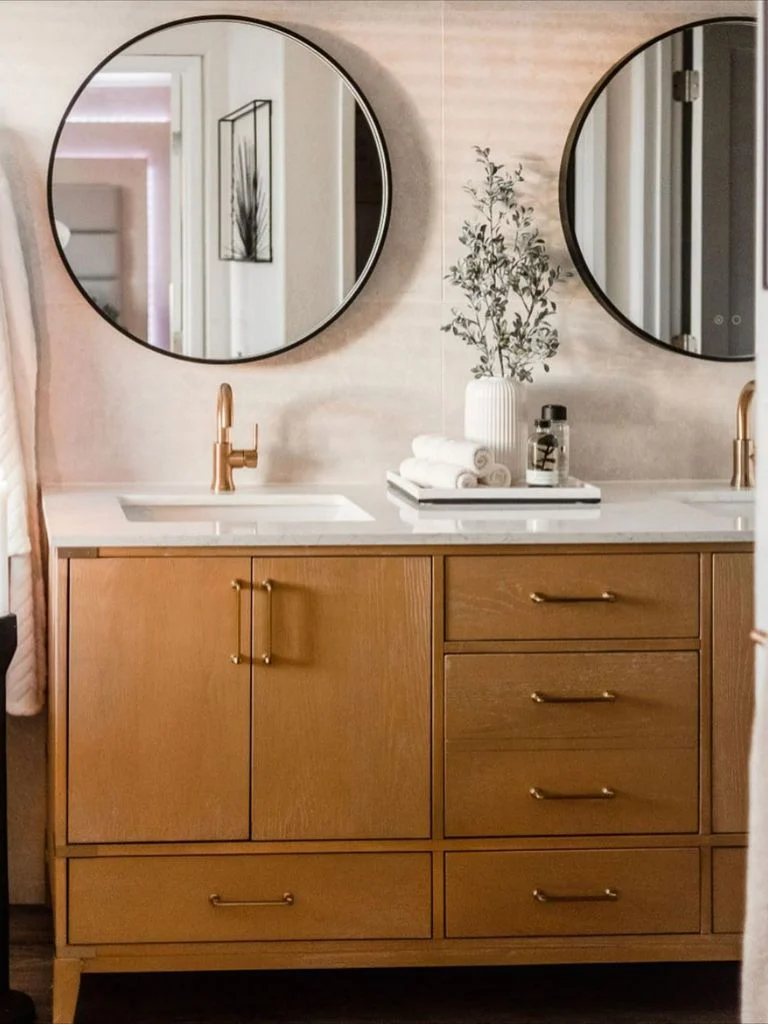
Borrow the relationship between the circles and the basins, rather than assuming the same mirror diameter will suit your cabinet. A wide vanity with closely spaced sinks presents a different composition from one with a broad drawer stack between them. Compare the mirror positions with the actual basin locations. Don’t overlook the wall at either end.
The open middle defines the pair. We’d keep a visible break when the appeal is the separate round shapes. That’s a visual preference, rather than a required spacing measurement.
For colors beyond the mirror wall, the bathroom decor examples connect existing finishes with towels and curtains. Settle the mirror outline first so those smaller choices have something clear to relate to.
Let a frameless rectangle follow the vanity’s straight lines
The round pair introduces curves; a frameless rectangle can continue the cabinet’s straight edges with less visible trim. In this bathroom, the rectangular mirror sits above a wood-toned vanity against a pale wall. Its fine edge leaves the reflection more noticeable than the border.
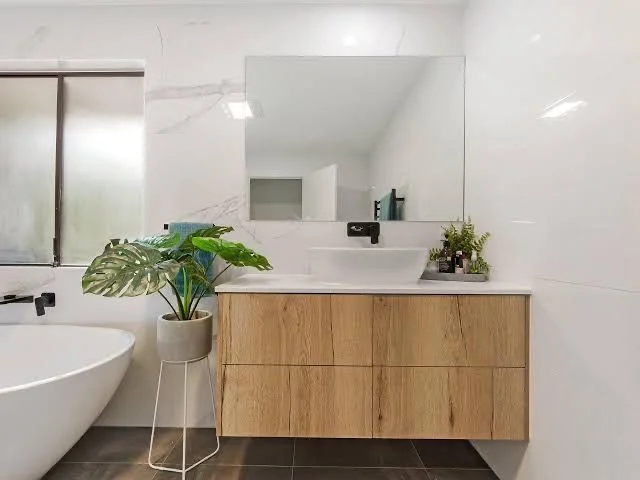
We’d consider this when the counter, tile, or cabinet already supplies enough detail. Adding an ornate border would introduce another outline to judge. You don’t need that extra detail. A simple edge lets you keep the attention on what’s already there, particularly when you like the vanity and only want the wall above it to feel settled.
Keep the reflection in the comparison. The example includes a doorway and ceiling in the glass, which become part of the view alongside the vanity. A spare product image isn’t the whole picture. Your room will appear in the glass too, whether that’s shelves, a patterned curtain, or an open door.
Use a dark mirror frame without matching every metal finish
The rectangle’s edge almost disappears, while the round mirrors in the first example have clearly drawn dark rims. Those rims share the room with gold-toned faucets and cabinet pulls. A mirror border can have a different color from the fittings while the arrangement still has a coherent direction.
Choose which pieces you want to connect visually. Here, the faucets and pulls form the warm-toned group; the mirror rims repeat their own dark outline across the wall. They don’t all match. Keep those roles clear if you’re borrowing the mixed-finish idea, so each color has a connection elsewhere in the view.
Frame thickness matters as much as color. A narrow dark rim draws a line around the reflection, while a broad border occupies more of the wall. Don’t choose by color alone. Look at how much frame you want to see before choosing a finish simply because it matches a towel bar elsewhere in the room.
Compare the mirror outline with the lights already in place
Once the frame feels right, include the existing light fittings in the view above the vanity. An overhead light occupies a different part of the wall from a fitting beside the glass. Don’t crop them out mentally. Compare the whole group, including the cabinet, rather than judging the mirror in a tightly cropped inspiration photo.
With an existing light above the sink, compare the mirror’s top edge with the fixture’s lowest visible part. A rounded top brings a curve into that gap; a flat top draws a horizontal line beneath it. We’d choose the shape that leaves each outline readable, especially when the light has a decorative shade of its own.
For lights beside the mirror, look at the fittings and glass together. A frame that feels delicate on its own may look busy beside detailed sconces. A plain frame can be enough when those lights already supply the decorative interest. Keep the fixture positions in the comparison while narrowing the mirror choices.
These are styling comparisons. Product suitability, mounting, and any electrical changes need their own assessment beyond the appearance shown here.
Decide whether the double vanity needs separate outlines
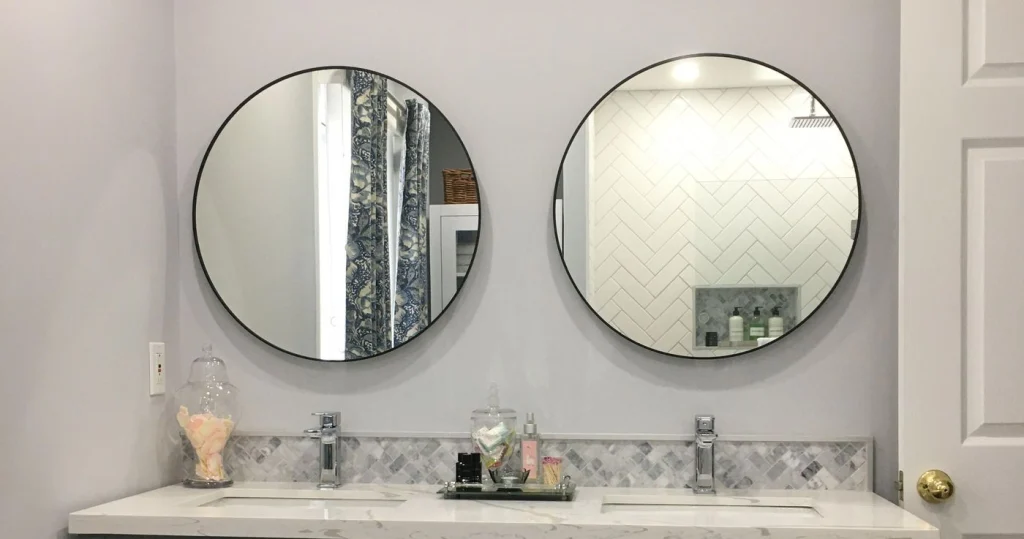
The lights help define the wall composition, and the sinks determine how you use it. At a double vanity, the matching round pair is a useful reference when you want each basin to feel distinct. The cover example uses the same idea over a gray cabinet, with a separate reflection in each circle.
If you’ve already got a broad mirror, first decide whether you enjoy its continuous reflection. You may prefer keeping that uninterrupted view and changing the visual details around it. A pair isn’t an automatic upgrade. Replacing the broad glass brings wall space between the separate mirrors into the composition.
Compare the options from both sink positions. The view from the doorway can make a pair look balanced while leaving out what each person sees directly ahead. You might like the symmetry from the entrance, then find that the view directly over a basin matters more to you when you’re using the room each morning.
The home decor guide considers both the broad room view and the place where an activity happens. At the vanity, the particular activity is looking into the mirror, so that direct view deserves attention before the surrounding styling is finished.
Let the reflection finish the bathroom mirror wall
After choosing the outline, look into the glass as well as around its edge. In the round-mirror cover example, a patterned curtain fills much of one reflection while shower tile fills the other. Matching frames don’t mean matching reflections. You don’t need another ornament to make both circles visually interesting.
Keep that reflected detail in mind when arranging the rest of the vanity. A busy reflection and a strong frame already give the wall plenty to look at. The bathroom tray arrangements offer ways to gather the daily pieces below without spreading decoration across the counter.
Before making a final choice, look at the mirror wall under the lighting you normally use in the evening. Notice the frame, the fittings, and the reflected room together. Keep the version whose outline you enjoy in that everyday view; ZM Home has more room ideas when another part of the home needs attention.
For ideas that bring the whole room together, explore Home Decor Ideas for Rooms You Use Every Day.